
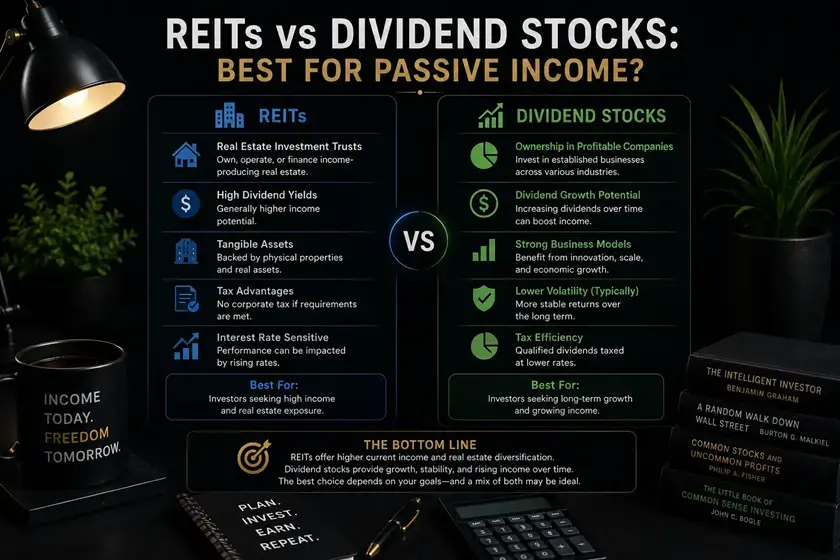
The Question That Actually Matters
The surface comparison is easy: REITs yield more. Average REIT yield sits above 4% in early 2026 - roughly triple the S&P 500’s yield of approximately 1%, and above the Dividend Aristocrats’ average of around 2.8%. If passive income is the goal, case closed.
Not quite. For international investors, the yield figure on a screen is not the yield you receive. US withholding taxes, FIRPTA exposure on share sales, and the fact that a typical REIT distribution contains three different income types - each taxed differently - can shift the after-tax picture significantly enough to reverse the apparent REIT advantage.
Most investors who arrive at this comparison have already decided they want REITs. The yield number convinced them. This guide is written for that investor specifically - the one who is about to commit capital to Realty Income or a REIT ETF and has not yet done the full tax math. The numbers may change the conclusion. They changed it for the case study at the end of this article.
This guide works through both sides with verified 2026 data and ends with a concrete recommendation for each investor profile.
Bottom Line Up Front
For most international investors in a taxable account, high-quality dividend stocks from US corporations are more tax-efficient than US REITs. REIT distributions attract 25% US withholding under the US-Israel treaty (vs. 15% on qualified corporate dividends), REIT share sales trigger FIRPTA withholding that standard equity sales do not, and the return-of-capital portion of REIT distributions - while not immediately taxable - reduces cost basis and creates a deferred tax liability at exit.
The calculation flips in two specific situations: investors holding inside a tax-advantaged account (Roth IRA or equivalent), and Israeli olim hadashim during their 10-year tax exemption window. In both cases, the REIT yield advantage is compelling because the tax drag is eliminated or substantially reduced.
What You Are Actually Buying
A REIT is a company that owns income-producing real estate - warehouses, data centers, healthcare facilities, net-leased retail, and more. To qualify under IRS rules, it must distribute at least 90% of taxable income annually. That mandatory distribution requirement drives the structurally higher yield. The average REIT dividend yield exceeds 4% in early 2026.
A dividend stock is a share in a corporation that pays regular cash dividends from retained profits. The Dividend Aristocrats - S&P 500 companies with 25+ consecutive years of dividend increases - number 69 as of 2026, with an average yield of approximately 2.8%.
The structural difference matters beyond just yield: because REITs must distribute 90% of income, they retain little capital for reinvestment. To grow, they raise debt and issue new equity - which dilutes existing shareholders and creates ongoing downward pressure on per-share values. Dividend growth companies retain earnings, compound internally, and grow both earnings per share and the dividend without that structural headwind.
The Performance Record: What the Data Actually Shows
NAREIT data through September 2025:
| Time Period | FTSE NAREIT All Equity REITs | S&P 500 |
|---|---|---|
| 1972-2024 (full history) | 12.6% annualized | 8.0% |
| Past 25 years | 11.7% annualized | 6.2% |
| Past 10 years | 7.2% annualized | 11.1% |
| Past 5 years | 5.5% annualized | 15.3% |
The long-term record favors REITs, including reinvested dividends - which account for roughly half of total REIT returns historically. The recent decade does not. REIT underperformance since 2015 reflects the rate cycle of 2022-2023 and the concentration of S&P 500 returns in tech stocks that REITs have no exposure to.
For individual reference: Realty Income’s 10-year annualized total return is 5.93% (FinanceCharts, May 2026). Coca-Cola’s 10-year annualized total return is 9.17% with dividends reinvested (AverageAnnualReturn.com, through April 2026). Both trails the S&P 500’s ~12.65% over the same period - but Coca-Cola’s total return was meaningfully stronger than Realty Income’s, despite the lower headline yield.
Neither the 25-year nor the 10-year record is “the right answer.” Both belong in any honest comparison. REITs are a legitimate long-term return vehicle, not merely a yield play - but their near-term performance is more rate-sensitive than diversified equities, and their recent decade of underperformance is real.
The Distribution Breakdown: What $100,000 in Realty Income Actually Generates
This is the dimension most income-focused comparisons skip entirely - and for international investors, it changes the withholding math on every distribution.
According to NAREIT’s analysis of 2024 distributions across all US-listed REITs, the average breakdown was:
- 78% ordinary income - rental income passed through to shareholders, taxed at ordinary rates
- 9% long-term capital gains - from property sales, taxed at capital gains rates
- 12% return of capital (ROC) - distributions exceeding taxable income, not immediately taxable
In concrete dollar terms on a $100,000 Realty Income position at 5.7% yield:
Annual gross distribution: $5,700
Applying the average breakdown:
- Ordinary income component (78%): $4,446 → after 25% US withholding: $3,335 received
- Capital gain distribution (9%): $513 → after 25% withholding (treated as ordinary for non-US investors): $385 received
- Return of capital (12%): $684 → $684 received now, but reduces cost basis by $684 (deferred tax at exit)
Total cash received year 1: $4,404 (vs. $5,700 stated gross yield) Effective after-withholding yield: 4.40% - not 4.28% as a flat calculation would suggest, because the ROC component arrives untaxed.
The ROC portion looks like free income. It is not. Each year’s $684 in ROC distributions reduces your cost basis by $684. After 10 years of holding, approximately $6,840 in ROC distributions have reduced the cost basis from $100,000 to roughly $93,160. When the position is sold, FIRPTA withholds 15% of gross proceeds regardless, and the taxable gain is calculated against the reduced basis - not the original purchase price.
The proportions vary by REIT. Net-lease REITs like Realty Income tend to have a higher ordinary income component than the industry average. Each REIT publishes its annual distribution breakdown on its investor relations page (Form 8937) and on 1099-DIV forms.
The Tax Layer: Three Charges That Don’t Apply to Dividend Stocks
For international investors, the headline yield is meaningless without adjusting for what the tax authorities keep. Three distinct tax mechanisms apply to foreign investors in US REITs - and only one of them applies to standard dividend stocks.
Charge 1: Withholding on Ordinary Distributions
The US default withholding rate on dividends paid to foreign investors is 30%. Filing a W-8BEN form with your broker applies treaty rates.
Critical distinction - what W-8BEN actually does for Israeli investors:
- On qualified dividends from US corporations: W-8BEN reduces withholding from 30% to 15% under the US-Israel treaty (Article 12)
- On REIT ordinary dividends: W-8BEN reduces withholding from 30% to 25% - the treaty cap for ordinary income under Article 12. Not 15%.
- On US interest income: the treaty caps withholding at 17.5% under Article 13 - the Interest article of the convention. Article 13 reduces the rate to 10% for certain banks, savings institutions, and insurance companies, and to 0% for government-backed debt. Verified from the IRS treaty technical explanation (irs.gov/pub/irs-trty/israel.pdf) and confirmed by taxesforexpats.com (April 2026).
This distinction is the source of most confusion among Israeli REIT investors. Filing a W-8BEN does not produce a 15% rate on REIT income. The 15% rate applies to qualified corporate dividends - income that REITs structurally cannot produce because their distributions are ordinary rental income, not qualified dividends.
Always verify the withholding rate your broker applies to each position. IBKR displays this in the tax detail of each security’s dividend history.
Charge 2: FIRPTA on Share Sales
When a foreign investor sells REIT shares, FIRPTA (Foreign Investment in Real Property Tax Act) requires the buyer’s broker to withhold 15% of gross sale proceeds - not 15% of the gain, but 15% of the total amount received.
A concrete example: an Israeli investor who bought $50,000 of Realty Income and sells for $70,000 faces $10,500 withheld at the point of sale (15% × $70,000). The actual tax owed on the $20,000 gain may be lower. A refund is available after filing Form 1040-NR with the IRS, but the cash is tied up until then, and the process requires engaging a US tax preparer.
Selling Coca-Cola or Johnson & Johnson triggers no FIRPTA. Capital gains on non-REIT US securities are generally not subject to US tax for foreign investors. The exit asymmetry between REITs and standard equities is genuine and significant for positions that have appreciated.
Charge 3: Basis Reduction from Return of Capital
Every dollar of ROC distribution received reduces your cost basis in the REIT position. When the position is eventually sold, that lower basis means a larger taxable gain - subject to both FIRPTA withholding and Israeli CGT. The ROC component defers the tax, but it does not eliminate it.
Numerical Comparison for Israeli Investors
| Investment | Gross Yield | US Withholding | Net After Withholding | Notes |
|---|---|---|---|---|
| Realty Income (REIT) | 5.70% | 25% (ordinary) | ~4.40%* | FIRPTA on exit; ROC reduces basis |
| NNN REIT | 5.85% | 25% (ordinary) | ~4.51%* | Same structure |
| Coca-Cola (KO) | 3.10% | 15% | 2.64% | No FIRPTA; qualified dividend |
| Johnson & Johnson | 3.20% | 15% | 2.72% | No FIRPTA; qualified dividend |
| Altria (MO) | ~7.3% | 15% | 6.21% | No FIRPTA; qualified dividend; high payout risk |
*Effective net yield accounts for ROC arriving untaxed, partially offsetting the 25% withholding on the ordinary income component. See distribution breakdown section above.
Israeli top-up tax applies to the net income in all cases. With REIT ordinary dividends at 25% US withholding and Israeli CGT at 25%, the treaty credit typically covers the Israeli liability on the ordinary income portion. With qualified dividends at 15% withholding, a ~10% top-up to Israel applies. Individual circumstances vary - verify with a tax advisor.
The Full 10-Year Case Study: Israeli Investor, $200,000, Taxable Account
This is the number that answers the question. Not gross yield. Not after-withholding yield. The full picture after 10 years of holding, including FIRPTA at exit.
Assumptions:
- Israeli investor, taxable account, not an oleh, W-8BEN filed
- $100,000 invested in each position simultaneously
- Realty Income (O): 5.7% gross yield, 10-year total return CAGR 5.93% (FinanceCharts, May 2026)
- Coca-Cola (KO): 3.1% gross yield, 10-year total return CAGR 9.17% (AverageAnnualReturn.com, through April 2026)
- All distributions spent, not reinvested - this is the income-investor scenario. This assumption is critical: if distributions are reinvested, the compounding dynamic changes substantially and Coca-Cola’s total return advantage over 10 years widens further, because reinvested dividends compound at the full pre-tax rate inside the position. For an investor who spends the distributions to live on - the primary audience for an income comparison - the numbers below apply.
- Israeli CGT 25% on capital gains at exit
- FIRPTA 15% of gross proceeds withheld on Realty Income sale (refundable but tied up)
Realty Income - $100,000 over 10 years:
Annual income (spent, not reinvested):
- Year 1 gross: $5,700 → after 25% withholding on ordinary portion: ~$4,404 cash received
- ROC component (~12% = $684/year) reduces cost basis by ~$684/year
- After 10 years: approximately $6,840 in cumulative ROC has reduced cost basis from $100,000 to ~$93,160
Cumulative income received over 10 years: ~$44,040 (10 × $4,404, simplified - actual varies with price and distribution changes)
Capital position at exit:
- At 5.93% CAGR (price only, distributions spent): $100,000 grows to approximately $177,800
- Sale proceeds: $177,800
- FIRPTA withheld at sale: 15% × $177,800 = $26,670 (refundable after Form 1040-NR filing)
- Taxable gain (Israeli CGT): $177,800 - $93,160 (reduced basis) = $84,640 gain
- Israeli CGT at 25% (net of US withholding credit): effective tax ~$21,160
- Net proceeds after tax: approximately $156,640
10-year total: $44,040 income + $156,640 net exit = ~$200,680
Coca-Cola - $100,000 over 10 years:
Annual income (spent, not reinvested):
- Year 1 gross: $3,100 → after 15% withholding: $2,635 cash received
- No ROC - cost basis remains $100,000
- Israeli top-up ~10% on net dividend: effective net ~$2,373/year
Cumulative income received over 10 years: ~$23,730 (income investor scenario - lower than O)
Capital position at exit:
- At 9.17% CAGR (price appreciation component, distributions spent): $100,000 grows to approximately $239,600
- No FIRPTA - no withholding at sale
- Taxable gain (Israeli CGT): $239,600 - $100,000 = $139,600 gain
- Israeli CGT at 25%: $34,900
- Net proceeds after tax: approximately $204,700
10-year total: $23,730 income + $204,700 net exit = ~$228,430
Summary:
| Realty Income | Coca-Cola | |
|---|---|---|
| 10-year income received | ~$44,040 | ~$23,730 |
| Net exit proceeds | ~$156,640 | ~$204,700 |
| Total 10-year return | ~$200,680 | ~$228,430 |
| FIRPTA cash tied up at exit | $26,670 | None |
| Tax filing complexity | Form 1040-NR required | Standard Israeli return |
Coca-Cola produces approximately $27,750 more in total 10-year return despite a headline yield less than half of Realty Income’s. The income investor who chose Realty Income received more cash annually - but left the building with less total wealth after tax.
Important caveats: This calculation uses historical CAGRs that may not repeat. Realty Income’s 5.93% 10-year CAGR is a period that included significant rate headwinds (2022-2023); a lower-rate environment could produce better capital appreciation. Coca-Cola’s 9.17% CAGR benefited from specific market conditions. The point is not that one will always win - it is that the tax mechanics materially close the yield gap, and the total return picture is the relevant comparison, not the headline yield.
The reinvestment scenario is different: If both investors reinvested all distributions rather than spending them, Coca-Cola’s total return advantage widens, because reinvested KO dividends compound inside the position at full CAGR. The comparison above is specifically for an income investor drawing distributions to spend. Investors who reinvest should run the full DRIP calculation - but the tax mechanics (25% vs 15% withholding, FIRPTA at exit) still apply and still favor KO over O in a taxable account.
Valuation Check: When Are REITs Worth Buying?
Yield spread over the 10-year Treasury is the most practical entry-point signal for REITs. Since 2000, the historical average spread between All Equity REIT yields and the 10-year Treasury is approximately 1.4% (NAREIT data).
With the 10-year Treasury at approximately 4.3% in early 2026:
- Average REIT yield ~4.0% → negative spread (-0.3%): expensive relative to history
- Realty Income ~5.7% → +1.4% spread: in line with historical average
- REITs yielding 6%+ → above historical average spread: historically signals fair-to-attractive valuation
Category-average REIT yields are not compelling at current rates. Individual quality net-lease REITs yielding 5.5%+ are at or above historical spread norms and represent reasonable entry points for investors who understand the withholding structure. This framework does not apply to dividend stocks in the same way - they are valued on earnings growth rather than income replacement.
Four Investor Scenarios: The Concrete Recommendation
Scenario 1: Israeli investor, taxable account, not an oleh 25% withholding on REIT distributions, 15% on qualified dividends, FIRPTA on REIT exit, ROC basis complications. The 10-year case study above quantifies the gap: Coca-Cola produces approximately $27,750 more in total return despite half the headline yield. Recommendation: Dividend stocks as the primary income holding. Consider a 10-15% REIT allocation only for real estate diversification and monthly cash flow, with full awareness of the exit tax mechanics.
Scenario 2: Israeli oleh, taxable account, within 10-year exemption US withholding applies, no Israeli tax on foreign-source income. Realty Income at 5.7% gross → ~4.40% effective after US withholding. Coca-Cola at 3.1% → 2.64% net. Recommendation: The REIT income advantage is genuine during the exemption window. Net-lease REITs as a meaningful allocation (20-30%) make sense here, paired with dividend growth stocks for the capital appreciation component. Note: the exemption window ends. Any REIT position built during the exemption will face Israeli CGT and FIRPTA at exit after the window closes - plan the exit accordingly.
Scenario 3: Any investor, Roth IRA or equivalent tax-advantaged account No US withholding inside a Roth, no domestic tax, distributions compound freely. Recommendation: REITs, unambiguously. The gross yield advantage is fully realized. Quality net-lease REITs belong inside tax-advantaged accounts.
Scenario 4: Long-term total-return investor, 15+ year horizon Dividend growth compounders with 2.5-3% yield and 8-10% annual growth outpace a static 5.7% REIT yield in dollar terms by year 13-15. They also carry no FIRPTA, lower withholding, and superior capital appreciation over 25+ year periods. Recommendation: Dividend growth stocks for long horizons. A 10-15% REIT allocation for diversification is reasonable - but income maximization over 15+ years favors dividend growth.
Specific Names Worth Knowing in 2026
REITs (best suited for tax-advantaged accounts):
Realty Income (O) - ~5.7% yield, monthly dividend, 31+ consecutive years of increases, 15,500+ properties across the US and Europe. Payout ratio approximately 75% of stable cash flow. Yield spread over current 10-year Treasury: approximately +1.4% - in line with historical average.
NNN REIT (NNN) - ~5.85% yield, 34 consecutive years of increases. Comparable net-lease model to Realty Income, slightly higher yield and similarly conservative balance sheet.
Avoid REITs yielding 10%+. Ultra-high REIT yields almost always reflect sector-specific risk (cannabis, heavy mortgage leverage, tenant concentration). The yield compensates for risk the market is pricing - it is not free income.
Dividend stocks (better suited for taxable accounts):
Coca-Cola (KO) - ~3.1% yield, 63 consecutive years of increases (Dividend King), 15% withholding, no FIRPTA, 9.17% 10-year annualized total return.
Johnson & Johnson (JNJ) - ~3.2% yield, 62 consecutive years of increases, 15% withholding, no FIRPTA, strong international revenue base.
Altria (MO) - ~7.3% yield, 15% withholding, no FIRPTA. Highest sustainable yield among well-known US dividend payers. Carry the risk of secular decline in tobacco volumes - the yield reflects that risk.
ETF versions:
VNQ (Vanguard Real Estate ETF) provides broad US REIT exposure. The same withholding rules apply to VNQ distributions as to individual REITs - 25% for Israeli investors on the ordinary income component. NOBL tracks the Dividend Aristocrats index equally weighted, annual rebalancing. SCHD combines yield screening and quality factors for dividend stocks - approximately 3.5% yield, 15% withholding. All three are US-domiciled; EU investors restricted to UCITS products can access equivalent exposures through iShares and Xtrackers UCITS ETFs.
Monthly vs. Quarterly: The Cash Flow Timing Difference
This is a practical consideration that yield comparisons ignore entirely.
Realty Income and NNN REIT pay monthly dividends. Most US dividend stocks - including virtually all Dividend Aristocrats - pay quarterly. For investors who rely on portfolio income to cover monthly expenses, the dividend payment cadence matters independently of the yield level.
A $200,000 position in Realty Income at 5.7% yields approximately $950 per month, paid monthly - after 25% withholding, approximately $713/month for Israeli investors. The same $200,000 in Coca-Cola at 3.1% yields approximately $1,550 per quarter - paid in April/July/October/January - or after 15% withholding, approximately $1,318/quarter for Israeli investors.
For investors in tax-advantaged accounts who reinvest all distributions, payment frequency is irrelevant. For investors drawing income to live on, monthly payment is a genuine operational advantage - even after the withholding differential.
The practical solution for investors who want monthly income from dividend stocks without REITs: build a portfolio across sectors with staggered quarterly payment dates. JNJ pays in March/June/September/December; KO pays in April/July/October/January; PG pays in February/May/August/November. A diversified Aristocrat portfolio of 6-8 names produces near-monthly income - though it requires more holdings than a single REIT position.
Common Mistakes
Comparing gross yields without adjusting for the withholding gap. 25% vs. 15% withholding on the same nominal distribution changes the effective yield meaningfully. Always calculate net-of-withholding yield before comparing positions.
Assuming W-8BEN reduces REIT withholding to 15%. It does not, for Israeli investors. W-8BEN applies the treaty rate - which is 25% for REIT ordinary income under the US-Israel treaty. The 15% rate applies to qualified corporate dividends only.
Treating return of capital as free income. ROC reduces your cost basis and defers a tax liability to exit. Combined with FIRPTA, the exit from a REIT position that received significant ROC distributions over its holding period produces a larger taxable gain than the investor expected.
Ignoring the FIRPTA cash flow impact. 15% of gross proceeds withheld at the point of sale - regardless of actual tax liability. For a $200,000 position that has grown to $350,000, that is $52,500 withheld at exit pending a Form 1040-NR filing. Planning for that cash flow event is not optional.
Treating all high REIT yields equally. 16% from a cannabis-sector REIT and 5.7% from Realty Income are not comparable risk profiles. The yield spread over Treasuries tells you what the market thinks of sustainability.
Cherry-picking the performance horizon. REITs outperformed the S&P 500 over 25 and 50 years. The S&P 500 outperformed REITs over the past 10 and 5 years. Realty Income’s 10-year total return CAGR is 5.93%; Coca-Cola’s is 9.17%. Both are true. Neither settles the forward-looking question.
Frequently Asked Questions
Are REIT dividends qualified dividends? No. REIT distributions are mostly ordinary income - rental income passed through to shareholders. They cannot be qualified dividends under US tax law, and they receive less favorable treaty treatment for international investors (25% withholding under the US-Israel treaty vs. 15% for qualified corporate dividends).
What is the actual breakdown of a REIT distribution? Based on NAREIT’s 2024 data across all US-listed REITs: approximately 78% ordinary income, 9% long-term capital gains, 12% return of capital. The breakdown varies by REIT and year. Each REIT publishes its annual distribution breakdown on its investor relations page (Form 8937).
Does W-8BEN reduce REIT withholding to 15% for Israeli investors? No. W-8BEN applies the US-Israel treaty rate to REIT ordinary dividends, which is 25% under Article 12 - not 15%. The 15% rate applies to qualified corporate dividends. Always verify the actual rate your broker applies.
What is FIRPTA and how does it affect REIT investors? When a foreign investor sells REIT shares, 15% of gross sale proceeds is withheld at the point of sale. This is a prepayment against actual tax owed, reconciled via a US non-resident tax return (Form 1040-NR). For retail investors owning under 10% of a publicly traded REIT, capital gain distributions received during the holding period are not subject to FIRPTA - only the share sale itself triggers FIRPTA withholding.
When is the yield spread attractive enough to buy REITs? The historical average spread of All Equity REIT yields over the 10-year Treasury since 2000 is approximately 1.4%. At current 10-year rates of ~4.3%, quality REITs yielding 5.7%+ offer spreads in line with historical norms. Category-average yields of ~4% do not.
Which is better for a Roth IRA? REITs, clearly. Inside a Roth IRA, US withholding does not apply and distributions compound tax-free. The gross yield advantage is fully realized without any drag.
The Verdict
For international investors in taxable accounts, the REIT yield advantage largely disappears once you run the full numbers. The 10-year case study above quantifies it: a $100,000 position in Coca-Cola (3.1% yield) produces approximately $228,430 in total 10-year return for an Israeli taxable-account investor. The same position in Realty Income (5.7% yield) produces approximately $200,680 - with the additional complication of $26,670 tied up in FIRPTA withholding at exit pending a US tax filing.
The income investor who chose Realty Income got more cash every year. They also left the decade with roughly $27,750 less in total wealth, and more administrative complexity at exit.
The answer reverses inside a tax-advantaged account or during an oleh’s exemption window. In those situations, REIT gross yield is largely what you receive, and quality net-lease REITs earning 5.5-6% gross belong in that account type.
Know your account. Know your tax status. Run the full numbers - not just the yield column.
*This article is for informational and educational purposes only. It does not constitute financial, tax, or investment advice. The 10-year case study uses historical total return CAGRs (Realty Income 5.93% per FinanceCharts May 2026; Coca-Cola 9.17% per AverageAnnualReturn.com through April 2026) that may not repeat. Yields cited reflect publicly available data as of May 2026. REIT distribution breakdowns are based on NAREIT 2024 industry data and vary by REIT and year. Tax treatment reflects general principles under the US-Israel tax treaty and Israeli tax law as of May 2026; individual circumstances vary. FIRPTA rules are complex and fact-specific. Consult a qualified US and Israeli tax advisor before making investment decisions involving US REITs.